Published on · 5 min read
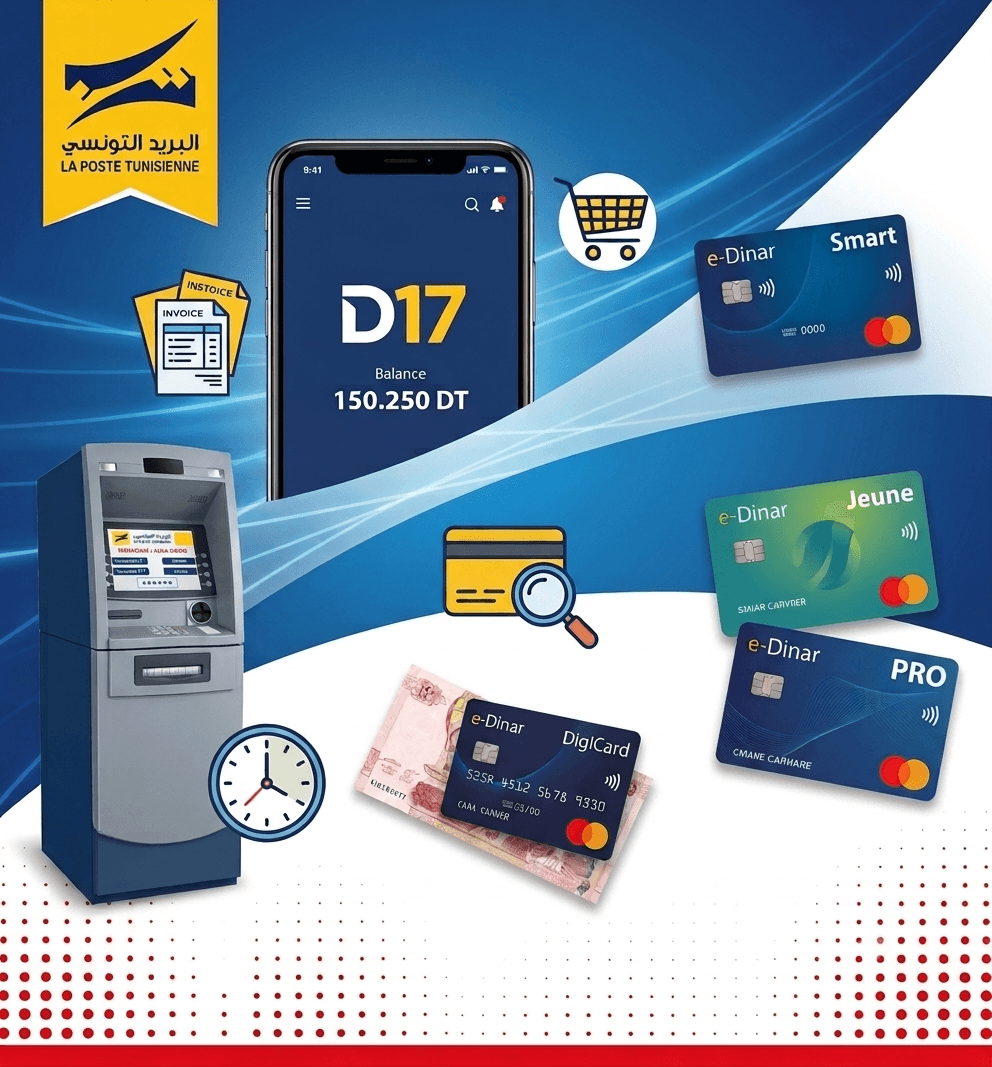
The D17 app is La Poste Tunisienne's smart digital wallet, designed to make payments, transfers, top-ups and account tracking effortless.
1. What the D17 ecosystem is, and the key difference between the app and the card
What is the D17 app, technically?
The D17 app is the mobile interface developed by La Poste Tunisienne to act as a digital wallet. Technically, the app does not hold money itself; it is a secure intermediary that links the balance stored on La Poste Tunisienne's servers to your mobile phone. It relies on secure tokenization technology: your bank or electronic card data is encrypted so it cannot be compromised when you pay in stores or online.
The e-Dinar card types (the engine behind the app)
D17 cannot run without "fuel", and that fuel is the e-Dinar card. Here are the details:
- e-Dinar Smart card: aimed at the general public, employees and independent professionals. It is used to withdraw cash from ATMs (DAB), pay bills and transfer money. It is renewed annually for a symbolic fee (around 10 dinars).
- e-Dinar Jeune card (for students): aimed at higher-education students and pupils. Its major advantage: it is the only card through which the university grant (bourse) and student loans are paid. It is also used for "remote enrolment" at universities and student residences.
- e-Dinar PRO card (for merchants): aimed at small-business owners, taxi drivers and shopkeepers. It offers a higher transaction ceiling and lets the merchant receive payments from customers via a QR Code directly in the app.
- DigiCard: aimed at online shoppers and paying national exam fees. It is a virtual card you never receive physically: you only get its numbers for digital use.
2. Why D17? An analysis of the economic and social benefits
- Ending the "queue dread": you can carry out 90% of postal operations from home. The app is also available 24/7, on Saturdays, Sundays and in the middle of the night.
- Financial inclusion: it provides a low-cost financial account for young people and those without a bank account, and encourages a "cashless" culture and less handling of paper money.
- Precise spending control (budgeting): the app offers an "operations history" so you know where your money went and get an instant, free account statement.
- Support for local e-commerce: any young person selling products via social media can immediately collect payment for their goods through the app.
3. Legal and technical requirements to obtain the service
Eligibility and required documents
- National ID card (CIN): it must be genuine and valid (linked to the civil-status database).
- Legal age: minors under 18 can obtain the e-Dinar Jeune card, which may require the guardian's consent.
- Mobile phone number (the essential condition): it must be registered in your name with the operator using the same CIN number linked to the postal card, in order to receive confirmation messages (OTP).
Phone technical specifications
- Android: the app requires a recent version (often Android 6.0 or higher).
- iOS: the store must be set to Tunisia to avoid compatibility issues.
- Internet connection: it is preferable to use mobile data (3G/4G) rather than public Wi-Fi during the first registration.
4. A practical guide to registration (the steps)
- Download and install: download the official version published by "La Poste Tunisienne" to avoid tampered apps.
- Choose the language: D17 offers a language choice (Arabic or French).
- Enter your identity and card details: CIN number (8 digits), e-Dinar card number (16 digits) and the card's secret code (4-digit PIN).
- Activation code (OTP): enter the temporary secret code sent by SMS. (If it does not arrive, make sure the number is registered in your name with the operator.)
- Create an app secret code: create a secret code specific to the app (D17 password) that differs from the card code.
- Final activation: once the code is accepted, the main screen appears with your current balance.
5. Advanced financial services explained
- Transfer management:
- International transfers (Western Union): enter the MTCN code (10 digits) to withdraw money immediately to the card.
- Mandat Minute: send money using a phone number; the recipient collects it via an SMS code from any ATM or post office.
- Pension payments: receive retirement pensions digitally.
- Bill payment: pay electricity and gas bills (STEG), water bills (SONEDE), and top up phone credit or internet bills (Topnet, GlobalNet, etc.).
- University services: remote enrolment (via the Inscription.tn website) and payment of university housing and canteen fees.
6. D17 for merchants and independent professionals
The phone can be turned into a payment terminal (Mobile POS), an alternative to expensive card readers. A QR Code is generated, and the customer scans it to pay the amount immediately.
- Avoid the change problem (small denominations).
- Financial transparency and easy tracking of daily sales.
- Very low commissions compared with banks.
- Payment of microloan instalments (such as Enda and Zitouna Tamween).
7. Cybersecurity and protecting your money
- Data confidentiality (PIN): never share your secret code with anyone. La Poste never asks for it by phone or message.
- Avoid digital storage: do not photograph your card and send it via messaging apps (Messenger, WhatsApp).
- Beware of phishing: watch out for fake pages claiming to offer prizes; the only official website ends in .tn.
- Secure your phone: enable biometric locking (fingerprint or face) and update the app regularly to close security gaps.
8. A guide to common troubleshooting
- Blocked account (Compte Bloqué): this happens after entering the wrong secret code 3 times. Unblocking is usually automatic after 24 hours, or you can call 1828.
- Failed transaction with the amount debited: pending operations are checked automatically and the amount is refunded within 24 to 48 hours (reconciliation).
- Forgotten secret code: use the "Forgot password" option and re-enter the card details and CIN to set a new code.
- Changing your phone number: go to the post office to fill in a data-update form.
- Lost or stolen card/phone: call 1828 immediately to request the card be stopped (opposition).
9. D17 compared with other banking solutions
- Cost: La Poste Tunisienne is the cheapest (annual maintenance fee between 8 and 15 dinars) versus the high commissions of banks.
- Reach: La Poste has the largest branch network in Tunisia (more than 1,000 offices), including rural areas.
- Technical strengths: D17 focuses efficiently on everyday micro-payments to be a truly popular app serving citizens' direct needs.
Useful links and sources
- Official website of La Poste Tunisienne: Portail de la Poste Tunisienne
- e-Dinar card website: e-Dinar Poste
- Unified money-order platform: Mandat en ligne
Final tip: always keep an eye on official updates to protect your personal data and enjoy a smooth financial experience.